

Have you ever walked into one room in your home and immediately noticed that it feels much warmer than the rest of the house? You may lower the thermostat, increase the fan’s speed, or adjust the vents, yet the same room continues to feel uncomfortable. A professional energy audit for hot rooms can help identify why that happens and determine which improvements can address the underlying problem.
Uneven cooling is not always caused by an aging air conditioner. Insulation gaps, air leakage, duct leakage, restricted airflow, heat gain through the building envelope, and HVAC imbalance can all contribute to persistent hot spots. A whole-home assessment looks at how these components interact instead of treating the uncomfortable room as an isolated problem.
At Star Energy Consultants, the focus is on understanding how the home performs as a complete system. Our energy audit process evaluates insulation, airflow, HVAC equipment, air leakage, and other factors that can affect comfort and energy efficiency.
Why Does One Room Stay Hot When the AC Running?
A properly functioning cooling system does not necessarily guarantee that every room will receive the same level of comfort. The home’s structure, insulation, ductwork, airflow, windows, doors, and HVAC configuration all influence indoor temperatures.
A room may remain warmer because:
- Conditioned air is not reaching it effectively.
- Ductwork has leaks or restrictions.
- Insulation is missing or uneven.
- Outdoor air is entering through gaps.
- The room receives significant solar heat.
- Return airflow is inadequate.
- Supply vents are blocked or restricted.
- The HVAC system is not distributing air evenly.
For a deeper look at the causes and solutions behind persistent hot rooms, explore our guide to hot room energy audits. Understanding these factors can help homeowners determine why adjusting the thermostat alone may not resolve uneven cooling.
What Is a Professional Energy Audit for Hot Rooms?
A professional energy audit for hot rooms is a detailed evaluation designed to determine why specific areas of a home experience excessive heat or uneven cooling.
Rather than examining only the air conditioner, an energy consultant evaluates the relationship between the home’s envelope and its mechanical systems. Star Energy Consultants describes its approach as a whole-house assessment that considers airflow, insulation, heating and cooling equipment, energy consumption, and overall home performance. The assessment may examine:
| Area Evaluated | What It Can Reveal |
| Insulation | Missing or insufficient insulation |
| Ductwork | Duct leakage and distribution problems |
| Airflow | Restricted or uneven conditioned-air delivery |
| Attic | Heat transfer and insulation deficiencies |
| Windows and doors | Air leakage and heat gain |
| HVAC system | Performance and distribution concerns |
| Building envelope | Areas where outdoor conditions affect comfort |
| Thermal patterns | Hidden temperature differences |
The goal is to gather information that can help determine which issues are contributing most to the hot room.
How Insulation Gaps Contribute to Hot Rooms
Insulation plays an important role in slowing heat transfer between the conditioned interior and the surrounding environment. When insulation is missing, compressed, uneven, or inadequate in key areas, heat can move through the building envelope more easily.
This is especially noticeable in rooms located:
- Directly below an attic
- Near poorly insulated exterior walls
- Above an unconditioned space
- Beneath areas exposed to significant solar heat
- Near sections of the home with inconsistent insulation coverage
During an energy assessment, insulation levels can be evaluated to identify areas where heat transfer may be contributing to temperature differences.
Star Energy Consultants’ home energy audit process specifically evaluates insulation levels as part of understanding overall home performance.
Why Attic Insulation Matters
Attics can have a major effect on the rooms below them. When the attic becomes extremely hot and insulation coverage is inadequate, additional heat can transfer toward the conditioned living space.
An audit can help determine whether attic insulation, ventilation, or air sealing issues are contributing to an uncomfortable upstairs room.
Rather than automatically adding more insulation, homeowners benefit from first understanding what the existing conditions are and whether other problems are involved.
How Duct Leakage Can Cause Uneven Cooling
Your HVAC system can produce cooled air without effectively delivering that air to every room.
Duct leakage is one potential reason.
When ducts leak, air conditioned can escape before reaching its intended destination. Depending on where the ductwork is located, cooled air may be lost into an attic, crawl space, wall cavity, or another unconditioned area.
This can result in:
- Reduced airflow at certain registers
- Rooms that remain warmer
- Longer HVAC operating cycles
- Uneven temperatures
- Increased strain on the cooling system
Duct leakage testing can provide valuable information about whether the duct system is contributing to comfort problems. Star Energy Consultants lists duct leakage testing among the diagnostic tools used to identify hidden energy inefficiencies.
Why Duct Problems Should Be Investigated Before Major HVAC Changes
Replacing an HVAC system may not solve an uneven cooling problem if the underlying issue is related to duct distribution or the home envelope.
A professional assessment can help determine whether the problem is associated with:
- Leaky ducts
- Restricted ducts
- Poor duct design
- Insufficient airflow
- Return-air limitations
- Other building-performance issues
This allows homeowners to make decisions based on actual findings instead of assuming that the equipment itself is responsible.
How Airflow Fixes Improve Room-to-Room Comfort
Even when ductwork is intact, a home can experience airflow problems.
A room may receive too little air conditioning because of a restricted duct, blocked register, improper distribution, or inadequate return-air pathways.
An energy audit can help identify these conditions and determine whether airflow improvements should be considered.
Understanding HVAC Imbalance
An HVAC imbalance occurs when heating or cooling is not distributed evenly throughout the home.
For example, one bedroom may receive strong airflow while another receives noticeably less. If the second room also has more exposure to outdoor heat, the temperature difference can become even more noticeable.
A whole-home approach considers both sides of the problem:
Heat entering the room + conditioned air reaching the room
This distinction matters because simply increasing cooling output may not address the underlying distribution problem.
How Air Leakage Affects a Hot Room
Air leakage occurs when unwanted outdoor air enters the home, or conditioned indoor air escapes through gaps and openings.
Potential leakage locations include:
- Around windows
- Around exterior doors
- Attic access points
- Plumbing penetrations
- Electrical penetrations
- Construction joints
- Other openings in the building envelope
Even relatively small openings can affect comfort when they are located in important parts of the home.
Star Energy Consultants uses blower door testing to identify how leaky a home is and thermal imaging to help locate areas requiring attention.
Connecting Air Sealing to Uneven Cooling
Air sealing can help reduce unwanted air movement through the building envelope.
When air leakage is contributing to a hot room, identifying and addressing that leakage points can improve temperature stability. It can also help the HVAC system operate under more controlled conditions.
The important step is identifying where leakage occurs before deciding what needs to be sealed.
How Thermal Imaging Helps Find Hidden Problems
Some causes of uneven cooling cannot be easily identified through a visual inspection.
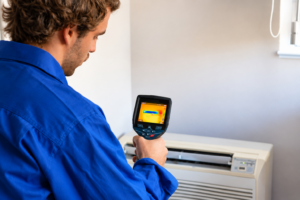
Thermal imaging provides a way to observe temperature differences across surfaces such as:
- Walls
- Ceilings
- Floors
- Windows
- Doors
Different temperature patterns may indicate areas requiring further investigation.
Thermal imaging can help identify potential:
- Insulation gaps
- Air leakage areas
- Heat transfer
- Moisture-related concerns
- Thermal inconsistencies
Star Energy Consultants incorporates thermal imaging into its diagnostic process to help locate hidden energy-performance issues.
What Happens During a Hot Room Energy Audit?
A comprehensive assessment typically follows several stages.
1. Understanding the Comfort Problem
The process begins by identifying the homeowner’s concerns. This may include a particular bedroom that remains hot, an upstairs area that overheats, or temperature differences between rooms.
Understanding when and where the problem occurs gives the consultant important information for the evaluation.
2. Inspecting the Home
The inspection can include the attic, insulation, exterior walls, windows, doors, HVAC equipment, and other areas affecting home performance.
Star Energy Consultants’ whole-home approach is designed to evaluate how these components interact.
3. Performing Diagnostic Testing
Depending on the home’s conditions, professional diagnostic equipment may be used.
This can include:
- Blower door testing
- Duct leakage testing
- Thermal imaging
- Airflow measurements
- HVAC performance checks
These tools help turn a general comfort complaint into measurable information.
4. Analyzing the Findings
The collected information is reviewed to determine which conditions are contributing to the hot room.
This step is important because several problems can produce similar symptoms.
5. Developing Targeted Recommendations
Once the causes have been identified, recommendations can focus on appropriate improvements, such as insulation upgrades, air sealing, airflow improvements, or HVAC-related measures.
The objective is to address the underlying conditions instead of repeatedly treating the temperature symptoms. Read our blogs to explore more insights on home energy performance, hot rooms, and ways to improve indoor comfort.
Why Choose Star Energy Consultants?
Star Energy Consultants focuses specifically on home energy audits and energy consulting rather than using audits primarily as a way to sell a particular upgrade. The company states that its role is to help homeowners understand their home’s performance and make informed improvement decisions.
The company’s approach combines:
- Whole-home energy assessments
- Insulation evaluation
- Air leakage testing
- Duct leakage testing
- Thermal imaging
- HVAC evaluation
- Data-based recommendations
- Guidance through energy improvements
This approach can be particularly useful when the problem is not immediately obvious.
Rather than assuming that the air conditioner is the problem, an energy audit looks at the complete system surrounding it.
Conclusion
A persistent hot room can be frustrating, especially when the rest of the home feels comfortable. However, uneven cooling can result from several interconnected issues, including duct leakage, insulation gaps, air leakage, restricted airflow, and HVAC imbalance.
A professional energy audit for hot rooms helps identify these conditions through a whole-home evaluation and diagnostic testing. By examining how the building envelope, insulation, ductwork, airflow, and HVAC system work together, homeowners can better understand the actual source of their comfort problem.
At Star Energy Consultants, the goal is to provide homeowners with clear information about how their homes perform and what improvements may help address identified problems. If your home has persistent hot spots or uneven cooling, contact us to discuss a home energy audit and take the next step toward a more comfortable and energy-efficient home.
Frequently Asked Questions
1. What is a professional energy audit for hot rooms?
A professional energy audit for hot rooms evaluates the home to determine why certain areas remain warmer than others. It can examine insulation, airflow, ductwork, air leakage, HVAC performance, and other factors affecting indoor comfort.
2. Can an energy audit find duct leakage?
Yes. Duct leakage testing can help identify whether conditioned air is escaping from the duct system before it reaches the intended room. This can help determine whether ductwork is contributing to uneven cooling.
3. Can insulation gaps cause room to stay hot?
Yes. Missing or insufficient insulation can allow more heat to transfer into a conditioned space. An energy audit can help identify insulation deficiencies and determine whether they may be contributing to the room’s temperature.
4. How can an energy audit identify airflow problems?
An energy assessment can evaluate airflow and HVAC distribution while also examining ductwork, registers, returns, and other factors. Diagnostic testing can help determine whether restricted or uneven airflow is contributing to the comfort issue.
5. Why choose Star Energy Consultants for hot room problems?
Star Energy Consultants takes a whole-home approach to energy performance. Its assessment process evaluates areas such as insulation, airflow, HVAC systems, air leakage, and ductwork to help identify the underlying causes of comfort problems.